Wednesday, May 29, 2019

"Be halde to ye hende." (Keep in mind, the end, your salvation.) An inscription by John Morow, a master mason, Melrose Abbey.

It was exciting to wake today and know we were escaping the city and heading for the Scottish borders. The train system here is so incredibly efficient and we were soon rolling our way to Tweedbank via Edinburgh. We spent about an hour stretching our legs in Edinburgh and reminiscing about the time we had spent there 9 years ago. Then onto a connecting train to Tweedbank. The scenery quickly changed from cityscape and industrial yards to pastoral landscape with those sweet black faced sheep dotting the countryside alongside the horses and cows and dry stone partitions separating the fields. Arriving, we were undecided whether to wait for a bus, call a cab or walk the 3 km to Melrose. The bicycle route looked walker friendly, so away we went, the happy wanderers. We checked into the Dunfermline House and then made our way to Melrose Abbey, which was incredible and I'll let the pictures tell the story.

The best mode of transportation!

 Arriving in Edinburgh and you see multiple levels of grey stone buildings in the old part of the city. 

 Greeted by two young bagpipers busking.

 Sir Walter Scott monument, the second largest monument in the world in memory of a writer.

 Edinburgh Castle in a commanding positon.

 Melrose Link - let's hike those 3 km and prepare for tomorrow!

 And this is where we will walk tomorrow, between the two mountains through the saddle. 

Melrose Abbey. A partly ruined monastery of the Cistercian order, founded in 1136 by Cistercian monks at the request of King David I of Scotland. It was a place beloved by Robert the Bruce (see previous post) and it is said that his heart is buried on the grounds. It was used as an abbey until the Protestant Reformation in 1560.

 The open window was actually a door where the monks would come down the steps from their sleeping chambers. You can see the formation of the bricks on the wall where stairs were attached. They would wash in the basin at the bottom and go for prayers at 2:00, 4:00, then 6:00 AM!

 The bell at the top of some very well worn steps.

Melrose Abbey from the side. It was an incredible tour, walking through history.

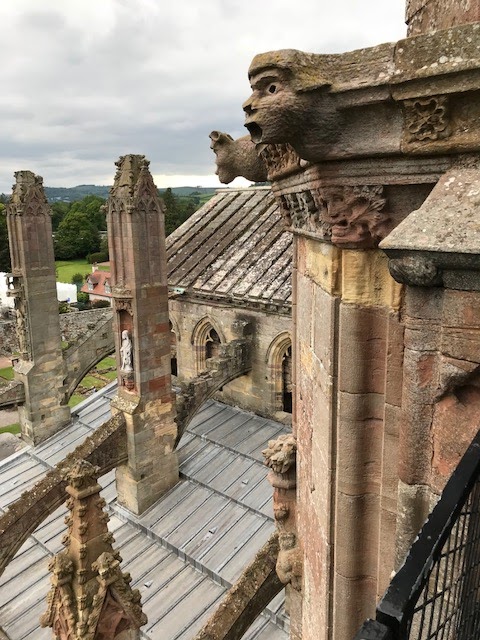
 On top of the Abbey. Grandchildren, notice the gargoyles. Gargoyles were added for two main purposes - to scare off evil and to divert rainwater.

 A steep spiral staircase leading up to the top of the Abbey to view the grounds from above.

 Nothing to say on this! (You can click on the picture to get a larger version.)

Dunfermline House - our B&B for one night before we set out on our hike.

Cheers to St. Cuthbert's Way - may it be kind to us!

Thank you for travelling along with us!

Tuesday, May 28, 2019

"If at first you don't succeed try, try and try again." ~ Robert the Bruce

It's an odd feeling being here - for me, it's like coming back to the homeland. Whether that is due to my ancestry or the fact that this particular part of the world enriches my knowledge of world history, I'm not sure, but I'm pretty sure I could live here for a time and feel quite at home.
Today we ventured north to Stirling, home of Stirling Castle, one of the largest and most important castles in Scotland, both historically and architecturally. Just a wee bit of history, the castle is strategically placed on Castle Hill surrounded on 3 sides by very steep cliffs, giving it a very important strategic position. Stirling Castle has been besieged 16 times. Most of the main buildings date from the 15th and 16th centuries so it was an afternoon spent wandering through this palace/castle and listening to the history complete with the lilt of a fine Scottish brogue from our tour guide named Charlie.
As we climbed the hill from the train station, the Stirling Baptist Church stood front and centre.

 After visiting the info centre and purchasing tickets for Stirling Castle, we walked uphill to Holy Rude Church ('Rude' or 'Rood' is the medieval term for the cross of the crucifixion). The first church on this site was founded by King David I in 1129. Mary Queen of Scots worshipped in this church and John Knox preached here. The coronation of James VI was in 1567 making this the only church in Britain, apart from Westminster Abbey, where a coronation has taken place. This is the King James who commissioned the King James Bible.

Could we please put some stone on our church and have sweet wildflowers growing from them? 

 This statue has several enclosed angels representing the heroes of the Scottish Presbyterian Reformation placed in the cemetery of Holy Rude Church. Considered one of these heroes, Margaret Wilson is remembered for refusing to renounce her protestant faith and so was executed by drowning at the very young age of 18.

The front of the church, the stained glass was very detailed and beautiful.

"Charlie" ~ highly recommend him as a tour guide if you ever get to Stirling Castle.

 King Robert the Bruce memorial located just outside the castle. The site of Bannockburn can be seen from here, where Robert defeated the English army. 

 View from atop the the castle. The vistas were vast and beautiful.

 The Great Hall where in 1594, James VI danced and feasted with the nobility in celebration of the baptism of his son, Prince Henry. 

 From a distance, the William Wallace monument. He was one of the main leaders of the Scottish independent movement in the late 1200's. One of his greatest victories was against the English in 1297. If you have seen 'Braveheart' starring Mel Gibson it would give you an overview of this history. Stirling sits on the edge of the highlands.

 The Scottish Highlands in the distance.

The Royal Residence with lovely gardens in the front and the Great Hall in the background. Originally all the buildings within the castle were the same colour as the Great Hall which would make this quite an impressive view. 

 See the indentation above the door? That is where a cannonball would have hit the castle, probably from Cromwell's army.  There are so many dents and holes in the structure from the many times it was attacked.

 The unicorn is a celtic symbol of purity and power and features in Scottish imagery as the lion does is England.

 These massive iron-studded oak doors are common throughout the castle.

 Standing atop the old stone bridge over the River Forth, near the site of the Battle of Stirling Bridge, then a wooden structure. This strategic site had to be crossed to defeat William Wallace whose memorial can be seen in the background.

 The four arch old stone bridge.

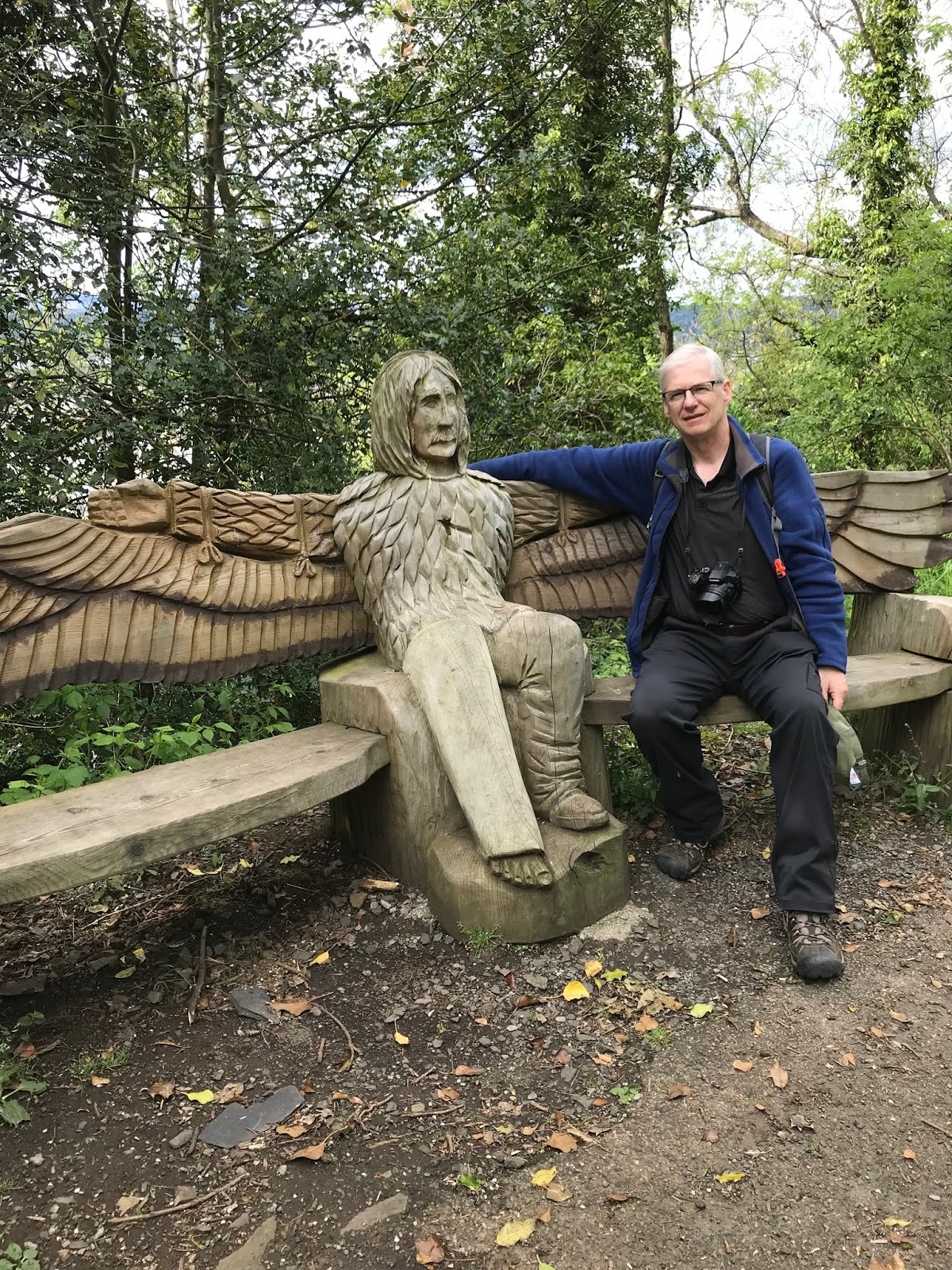
 Walking down from Stirling Castle, we came across this carving of John Damian de Falcuis. This man was a physician to James IV and in 1507 claimed he would fly to France (see the wings?). He made these and launched himself from the castle walls. His only injury was that he broke his thigh - see the cast? What was he thinking? Or was he?

 Trying to locate the old stone bridge, this fellow decided to walk along with us and help us find our way. Had a great conversation with Andrew but I think he only understood every few words. It was fun listening to him talk though!

I had to capture a picture of the rooftops - if you put your imagination to work you can almost see Bert and his fellow chimney sweeps up there dancing from roof to roof.

 A special treat for our train trip back to Glasgow.

Monday, May 27, 2019

"Be happy while you're living, for you're a long time deid." - Old Scots proverb

After a very long night aboard our Westjet flight (actually just under 5 hours!), we arrived in Glasgow, Scotland. There did not seem to be any kiosks around that were available to help 2 very tired Canadian tourists. So, putting our frugal roots into play, we decided to walk, yes, walk to the train station to catch a train into the city centre. Well, if you know me, I'm basically directionally challenged, so Andrew went into his leadership, map fanatic mode and we found the station, hopped on a train and arrived at Glasgow Central Station around 9 am (5 am Nova Scotia time). We were sooo tired, but I called the hotel to see if we could drop our bags off (check in was not until 3 pm). They were very accommodating and so we quickly found a small restaurant and had breakfast, hoping that would revitalize us enough to get us through to check in time and a wee nap in the late afternoon. 

This is the train station at Paisley Gilmour that we trudged to early this morning. There is always lots of verbal as well as written caution to 'mind the gap'.

Glasgow Central Station, a beautiful old building and the hub for many trains travelling to and from.

Not sure how many are familiar with the Dr. Who tv shows. This is a police box located right in the midst of the shopping district.

We found a major bookstore (5 levels) called Waterstones on Sauchiehall Street. We spent the bulk of the afternoon here browsing and I was fortunate enough to find a cushy chair to sit, falling asleep while waiting for Andrew. Not sure what the other patrons thought! We then found out it was the largest bookshop in Scotland. The above picture is a Harry Potter common room found here with lots of Harry Potter things to purchase.

A little corner of the Harry Potter room.

Glasgow is a port city on the River Clyde in Scotland. It is famed for its Victorian and art nouveau architecture, a rich legacy of the city's 18th-20th century prosperity due to trade and shipbuilding. Today it's a national cultural centre being the 3rd most populous city in the UK. There is a huge shopping area with pedestrian walkways and lots of pink banners stating 'people make Glasgow'.

 A taste of the architecture in this city. Quite lovely.

 These 2 women watching over those entering the Merchants House building, built in 1877.

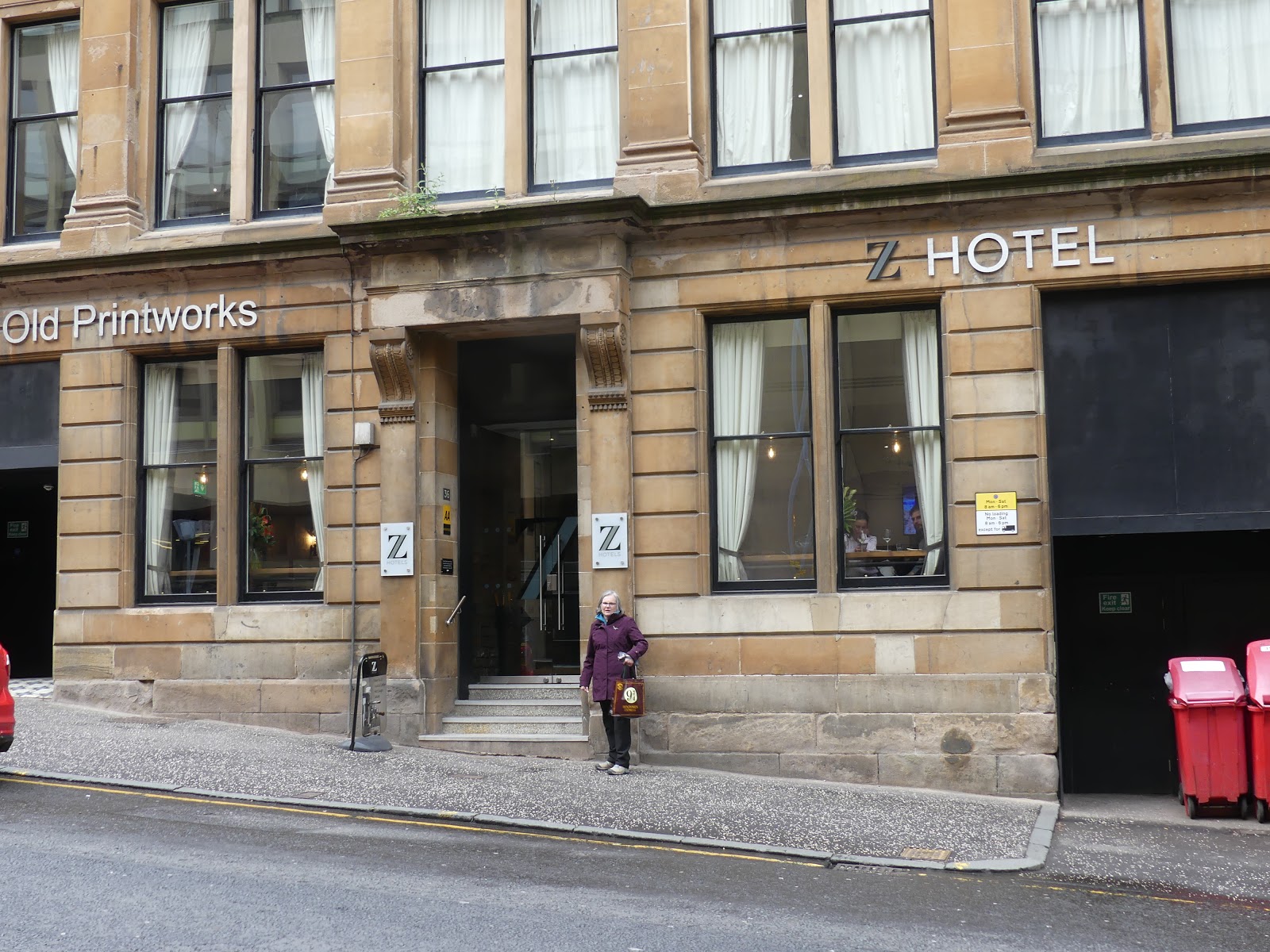
And our little hotel for 2 nights where we will hopefully get our systems adjusted to the time change. The room is very small but has everything we need and really central to the downtown core.

Well, that's it for today. Time to get ready to hit the sack and probably head off to Stirling in the morning.

Sunday, May 26, 2019

"We travel not to escape life, but for life not to escape us."

Just a pre blog for our soon to be adventure, hiking St. Cuthberts Way beginning in Melrose, Scotland and ending on Lindisfarne (Holy Island). A few facts about St. Cuthbert, flags of the countries we will be travelling in and hopefully we can capture your interest in this picturesque landscape that we love to explore.

The flag of Scotland, also known as St. Andrews Cross. Malcolm, how is this flag similar to our Nova Scotia flag?

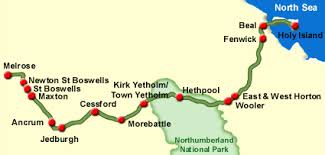
This is St. Cuthbert's Way, a 67 mile (106 kilometre) hike. We will walk this over 7 days and arrive in Beal, hopefully at low tide, where we will cross over to Holy Island.

The flag of England. We will walk into England on the fifth day as we leave Kirk Yetholm and head into the Cheviot Hills.

 
Some of the scenery we will encounter along the way. Hopefully those clouds aren't holding any rain.

 An image of St. Cuthbert I found online. St. Cuthbert was born in 634 AD and died in 687 and was a saint of the Northumbrian Church. He was a monk, a bishop and a hermit. He was also known widely as the great wonder worker of Britain because of his reputation for gifts of healing and insight, leading many people to consult him. He engaged in extensive missionary work travelling the breadth of the country on foot.


As we travel this pilgrimage, we hope to learn more about St. Cuthbert, explore some castles and keep you all updated on our progress.